1919 — 1945 · Korean Provisional Government

Names never found in textbooks —
Finding the stories of
the women who sustained the Provisional Government

One story I stumbled upon in Sydney brought me all the way here.
The more I learned, the more I wanted to know — their real stories, hidden in history.

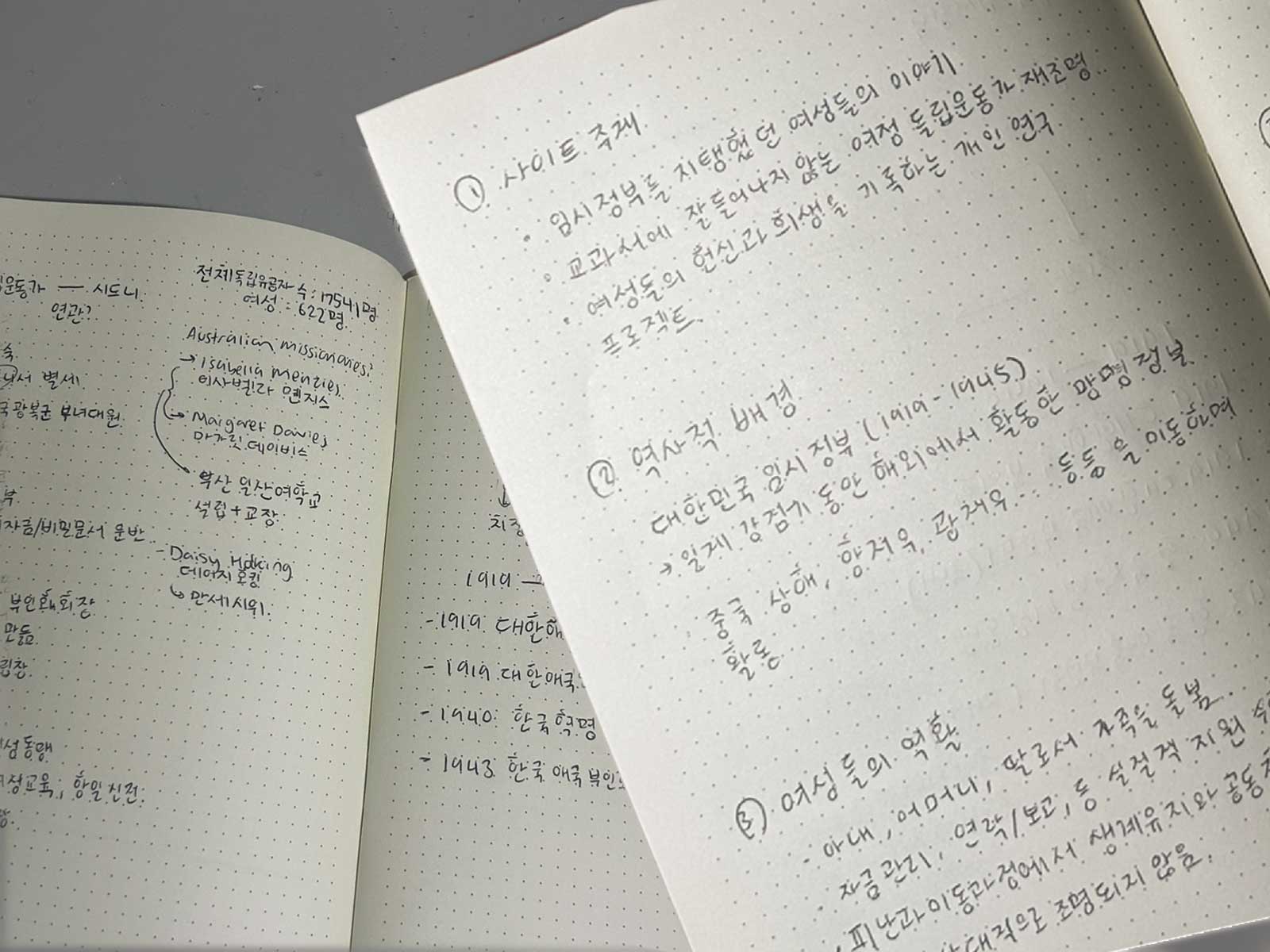
시드니 한인 역사 자료를 조사하는 모습

In Sydney, tracing a history I never knew

Honestly, I Had
No Idea

Hi. I'm a second-generation Korean-Australian studying at university in Sydney. I thought I knew about Korea, but one day I stumbled upon the story of patriot Shin Jeong-suk, and everything changed.

There were Australian missionaries right here in Sydney who helped Korea's independence movement, and independence fighters who were active in this city. I had no idea until then. As I dug deeper, I found myself drawn to the stories of the women who sustained the Provisional Government.

What surprised me even more was that while over 17,000 people have been recognized as independence patriots, only 3.5% of them are women. So I started searching, and that's how this page came to be.

— From Sydney, still learning
17,541
Total independence patriots
622
Women among them (3.5%)
26 yrs
Duration of the Provisional Government
~3,200km
Refuge distance, Shanghai to Chongqing

Babies on their backs, documents hidden in their clothes,
they walked 3,200 kilometers

The Provisional Government could never stay in one place. They had to cross the Chinese mainland to escape Japanese pursuit, and women and children were with them every step of the way. Click on the cities below.

四川 湖北 湖南 江西 江蘇 浙江 福建 廣東 廣西 貴州 山東 武漢 南昌 福州 香港 ~180km ~200km ~900km ~800km ~700km Start End Shanghai 上海 1919–1932 Hangzhou 杭州 1932 Zhenjiang / Nanjing 1935 Changsha 長沙 1937 Guangzhou / Liuzhou 1938 Qijiang 綦江 1939 Chongqing 重慶 1940–1945 N ~500km
Click on a city to see what happened there
1919–1932
Shanghai 上海
City of beginnings
1932
Hangzhou 杭州
The first flight
1935
Zhenjiang / Nanjing
A brief respite
1937
Changsha 長沙
The night of the great fire
1938
Guangzhou / Liuzhou
The endless march
1939
Qijiang 綦江
Coming together again
1940–1945
Chongqing 重慶
The last stronghold

Shanghai — Where it all began

Shanghai, where the Provisional Government was established in 1919. Women were part of it from the very start. The Korean Patriotic Women's Association was founded, and women like Jeong Jeong-hwa secretly transported independence funds back and forth between Korea and Shanghai. Cooking meals for government officials in cramped rented rooms in the French Concession, doing laundry, handling communications — that was the daily life of these women during this period.

💬 Even back then, the line between "keeping house" and "fighting for independence" didn't really exist.

Hangzhou — The frantic first flight

After Yun Bong-gil's bombing in 1932, Japanese pursuit intensified. The Provisional Government hurriedly relocated to Hangzhou, and the women had to hide important documents and official seals on their bodies while moving from one safe house to another with children in tow. There were more nights than they could count when they had to pack their bags without even knowing where they were headed.

💬 Somewhere in the luggage they lost during those moves, there must have been precious photographs and letters...

Zhenjiang / Nanjing — A moment to catch their breath

With help from the Chinese Nationalist Party, they could stay for a while, but the financial hardship continued. The women began learning Chinese to communicate with the local community, and they took charge of educating the children themselves. Making sure they wouldn't forget Korean. Making sure they wouldn't forget Korean history.

💬 As a second-generation Korean living abroad, this part really hit home for me. The weight of preserving a language.

Changsha — Escape through a sea of fire

The Great Fire of Changsha in 1938. On the night the entire city was engulfed in flames, the Provisional Government families had to flee for their lives. Some families lost young children in the chaos. I can't even imagine the terror of having to run through the flames carrying a child.

💬 Stories like these... I never saw a single line about them in any textbook.

Guangzhou / Liuzhou — Footsteps that could not stop

Fleeing Japanese air raids, heading south, then west. Everyone was exhausted by the never-ending exodus, but the women kept the march going while caring for the elderly, the weak, and the children. With scarce food and medicine, they took charge of nursing and cooking, organized communal meals, and taught the children Korean.

💬 Teaching children Korean while walking. That in itself was an act of resistance.

Qijiang — Regrouping and organizing

After arriving in Qijiang near Chongqing, the women moved beyond the era of simply fleeing and began organized activities in earnest. Groups like the Korean Revolutionary Women's Alliance were formed around this time, and women's independence activities started taking on a more systematic shape.

💬 The fact that they built organizations and stood in solidarity no matter the circumstances — that's truly remarkable.

Chongqing — At last, liberation

The Provisional Government's final stronghold. Here, women's activities reached their peak. Female soldiers enlisted in the Korean Liberation Army and directly participated in military operations like propaganda broadcasts to enemy lines, codebreaking, and prisoner interrogation. When they heard the news of liberation in 1945, what must they have been thinking?

💬 Hearing the news of liberation after enduring 26 years... did they cry, or did they laugh?

Meet the Women

Not "someone's wife" — these are people who deserve to be remembered by their own names. Click on a card to read their full story.

What We've Been Missing

🍚

A single meal was an act of resistance

The Provisional Government officials could carry on their work because someone was cooking, doing laundry, and caring for the sick. That "someone" was almost always a woman, and this labor was never recognized as "independence activism."

📻

They didn't just carry guns

Female members of the Liberation Army broadcast propaganda in Japanese to enemy lines, decoded ciphers, and interrogated prisoners. Women fluent in Japanese were essential personnel in psychological warfare operations.

🕯️

Losses that went unrecorded

Babies born during the flight who didn't survive long, women who collapsed from malnutrition, women who lost their husbands yet stayed with the Provisional Government. Stories like these are almost entirely absent from the official record.

✉️

Missions only women could carry out

Because Japanese surveillance was focused on men, women strategically served as couriers for independence funds and secret documents. This is the context behind Jeong Jeong-hwa's 13 border crossings.

Forgotten Names,
Found in Sydney

This is the story that started it all. Living in Sydney, I had no idea about the deep connection between Korea's independence movement and Australia.

Sydney's Liberation Army Veteran · 1917–1997

Patriot Shin Jeong-suk — "The Liberation Army grandmother who lived among us"

Born in Boeun, Chungcheongbuk-do in 1917, she served as a female member of the Korean Liberation Army, participating in psychological warfare and propaganda activities. In the late 1970s, she moved to Sydney to join her children and lived here for about 20 years. She passed away in Sydney in 1997, and in 2001 her remains were repatriated to Korea and interred at the Daejeon National Cemetery.

Korean community members remember her like this — "We thought she was just an ordinary grandmother next door, but it turned out she was an independence fighter who had carried a gun."

There are almost no articles about her in mainstream Australian media. She lived in Sydney for 20 years, but Australian society didn't know she existed then, and still doesn't now.

Try searching for yourself

She lived in Sydney for 20 years — is there any record in Australian media? Try entering these search terms on Google.

"Shin Jeong-suk" Sydney "신정숙" 호주 "신정숙" 시드니 Korean independence fighter Sydney

Nothing comes up.

A decorated independence patriot — a veteran of the Liberation Army — lived and died in this city over 20 years, and there is no record of her anywhere in Australia. This is one of the reasons I made this page.

Busan Ilsin Girls' School · Australian Missionaries

Australian women who helped Korea's independence

Australian missionaries based at Busan's Ilsin Girls' School directly supported students' independence activities during the March 1st Movement of 1919. The Korean government awarded them medals of honor, and Australian media covered them as "Australian heroes who helped Korean independence."

Isabella Menzies

Belle Menzies · ?–1935

Founder of Ilsin Girls' School. During the March 1st Movement, she protected students and helped them make Korean flags.

Margaret Davies

Margaret Davies · ?–1963

Principal of Ilsin Girls' School. She supported the students' independence protests. She passed away in Melbourne.

Daisy Hocking

Daisy Hocking · ?–1971

She joined the independence protests alongside the students and was even arrested by the Japanese authorities.

There is still no place in Australia that honors them

In Sydney, where Shin Jeong-suk lived for 20 years, and across Australia where Menzies and Davies returned — there is no memorial or monument dedicated to any of them. The Korean-Australian community has held commemorative events, but within Australian society as a whole, this history remains virtually unknown.

Apart from brief coverage when the Australian missionaries received medals from the Korean government, mainstream Australian media has shown almost no interest. The phrase "independence fighters forgotten overseas" fits this situation perfectly.

💬 I lived in the same city and didn't know this story. I wanted to record it now, even if it's late. If there's no memorial, at least there can be this page.

They Fought Together, Not Alone

1919
Korean Patriotic Women's Association (대한애국부인회)
A women's independence organization formed right after the establishment of the Provisional Government. They raised independence funds, carried out Red Cross activities, and cared for the families of independence fighters.
Kim Sun-ae, Lee Hwa-suk, Oh Eui-sun, and others
1919
Korean Patriotic Women's Society — Domestic (대한민국애국부인회)
This group secretly raised independence funds within Korea and sent them to the Provisional Government. After being discovered, key members were imprisoned, but underground activities continued.
Kim Maria, Hwang Ae-siduk, and others
1940
Korean Revolutionary Women's Alliance (한국혁명여성동맹)
An organization in Chongqing where women from both left and right came together. They systematically conducted anti-Japanese propaganda, supported the Liberation Army, and organized women's education.
Bang Sun-hee, Kim Jeong-suk, Yeon Mi-dang, and others
1943
Korean Patriotic Women's Association — Rebuilt (한국애국부인회)
The women's association re-established in Chongqing. They supported the Liberation Army, produced propaganda materials, and nursed wounded soldiers, staying active right up until liberation.
Kim Sun-ae, Bang Sun-hee, and others

These are the resources I studied

Memoir

Janggang Ilgi (Yangtze Diary) — Jeong Jeong-hwa

26 years alongside the Provisional Government. The most vivid record of daily life in the Provisional Government, written from a woman's perspective. I really recommend this book.

View on Kyobobook →
Official Archive

e-Gonghun Archive

You can look up official records and photos of independence patriots. Search a name and you'll find more information than you might expect.

e-gonghun.mpva.go.kr →
Primary Sources

Provisional Government Document Collection

Published by the National Institute of Korean History. You can view original source documents, which include a fair amount of material related to women. Fully digitized.

Korean History Database →
Search System

Korean Independence Movement Information System

Integrated search run by the Independence Hall of Korea. Biographical entries, photographs, donated materials, and catalogs — well-organized by individual.

search.i815.or.kr →
Memorial Hall

National Museum of Korean Provisional Government

Opened in 2022. Features a digital archive and metaverse experience. Located in Seodaemun-gu, Seoul. Free admission.

nmkpg.go.kr →
Encyclopedia

Encyclopedia of Korean Culture — Provisional Government

Run by the Academy of Korean Studies. Entries on the Provisional Government and female independence activists are well-organized with academic rigor.

encykorea.aks.ac.kr →
Memorial Project

Anti-Japanese Women's Independence Movement Memorial Association

Hosts memorial cultural festivals honoring female independence activists, field trips to Manchurian independence movement sites, and seminars.

herstorykorea.org →
Online Exhibition

Independence Hall Digital Museum

VR exhibition hall and AI digital human exhibits. For the 80th anniversary of liberation in 2025, you can even have conversations with AI-restored independence activists.

i815.or.kr/digitalHall →
Online Lectures

Independence Hall Education Portal

Free online courses. Includes a 30-day program on "The Beginning of Korea: The Provisional Government." Available for overseas learners.

learn.i815.or.kr →
Museum

Seodaemun Prison History Hall

You can see Cell 8 of the women's detention block where patriot Yu Gwan-sun was held. Also offers metaverse experiences and hologram exhibits.

sphh.sscmc.or.kr →
Australia-related (Korean)

Australian missionaries named Independence Patriots of the Month

Menzies, Davies, Hocking — the Australian missionaries at Busan's Ilsin Girls' School who aided the March 1st Movement. Kyunghyang Shinmun, 2024.

Kyunghyang Shinmun article →
Australia-related (English)

Korean Awards for Australian Missionaries

Presbyterian Church of Victoria — The story of three Australian women missionaries who received Korean government honors. Belle Menzies was the aunt of Australian Prime Minister Robert Menzies.

pcv.org.au →

Do you know a story we've missed?

There's a limit to what one person can find alone.
People, events, documents, photos, oral records — anything helps.
Corrections and words of encouragement are equally welcome.

Send Feedback